
Industry Background & Operational Challenges
Aluminum processing operations—cutting, grinding, polishing, CNC machining, and surface finishing—generate large volumes of fine metallic dust. Unlike conventional mineral dust, aluminum particulates present a dual challenge: filtration efficiency + explosion risk control.
From field projects we’ve supported, aluminum dust typically exhibits:
- Particle size: 0.1–100 μm
- High airborne dispersion tendency
- Low moisture content
- Strong combustibility
Fine fractions below 10 μm remain suspended longer and pose both respiratory and ignition hazards.
Additionally, the minimum explosive concentration (MEC) for aluminum dust is extremely low, meaning small accumulation in ductwork or collectors can create deflagration risks if ignition sources are present.
This makes dust collection design not only an environmental requirement—but a critical safety system.
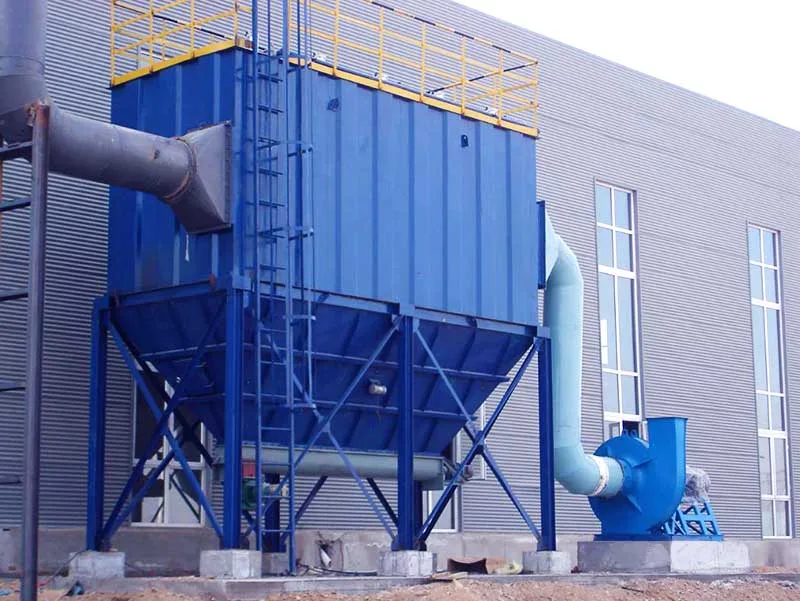
Working Principle & Technical Filtration Considerations
1. Dust Capture & Conveyance
Aluminum dust is typically extracted via localized hoods connected to high-velocity duct systems. Transport velocity must remain above minimum conveying thresholds to prevent particle dropout.
2. Separation Stages
A typical engineered system may include:
- Cyclone pre-separator
- Baghouse or cartridge collector
- Explosion isolation / venting
Cyclones are often used for high dust loading environments due to their ability to handle large particulate volumes and extreme temperatures.
3. Filtration Mechanism
In pulse-jet baghouses:
- Dust-laden air enters the dirty chamber
- Particles deposit on filter bag surfaces
- Clean air passes through media
- Pulse cleaning removes accumulated cake
Proper dust cake formation is essential—too aggressive cleaning increases emissions; insufficient cleaning increases pressure drop.
Filter Bag Selection for Aluminum Dust
Selecting the correct filter media is not just a temperature decision—it involves conductivity, spark risk mitigation, and dust release performance.
Based on aluminum dust characteristics and field installations, the following media are commonly applied:
Polyester Needle Felt
- Cost-effective baseline solution
- Suitable for low-temperature aluminum processes
- Can be treated with oil/water repellency
- Optional anti-static finish
Meta-Aramid (Nomex® equivalent)
- Continuous temperature resistance up to ~200°C
- Better thermal stability for hot machining exhaust
PPS (Ryton® equivalent)
- Chemical resistance in alloy processing environments
- Stable under acidic or sulfur-bearing fumes
Polyimide (PI / P84® type)
- Superior high-temperature filtration
- Excellent fine particulate capture efficiency
- Recommended for high-heat grinding or furnace off-gas
Anti-Static Filter Bags (Critical)
Because aluminum dust can accumulate electrostatic charge, anti-static constructions are frequently required:
- Conductive fiber blended felts
- Surface conductive treatments
- Grounded cages & venturis
Baghouse modules designed for aluminum dust often specify anti-static or explosion-proof configurations depending on hazard classification.
Omela Filtration Engineering Solutions & Advantages
From an engineering supply perspective, aluminum dust projects require more than just media supply—they require system matching.
Omela provides:
1. Application-Matched Media Engineering
We evaluate:
- Operating temperature profile
- Dust loading (grains/ft³)
- Particle abrasiveness
- Explosion classification
This ensures proper selection between polyester, aramid, PPS, or PI.
2. Anti-Static & Safety Configurations
Available options include:
- Conductive scrim felts
- Copper wire grounding
- Anti-spark finishes
These mitigate electrostatic buildup inside collectors.
3. Custom Fabrication
We support:
- Custom diameters & lengths
- Snap band / cord / flange tops
- Reinforced wear cuffs
- PTFE membrane lamination
4. High Dust Loading Durability
Engineered felts maintain filtration stability even under high inlet dust concentrations typical in metal finishing lines.
Application Scenarios
Aluminum dust filtration systems are widely deployed across:
Aluminum Casting & Foundries
Furnace charging, shot blasting, and fettling operations.
CNC Machining & Milling
Dry cutting of aluminum billets and plates.
Grinding & Polishing Workshops
High fine-dust generation environments.
Powder Coating Lines
Overspray recovery combined with metal dust extraction.
Battery & EV Component Manufacturing
Lightweight aluminum enclosure machining.
Each scenario demands different air-to-cloth ratios, filtration velocities, and media finishes.
Engineering Design Notes
When designing aluminum dust collection systems, engineers must consider:
- Explosion venting & isolation
- NFPA combustible dust compliance
- Spark detection & suppression
- Hopper discharge sealing
OSHA exposure limits for respirable aluminum dust must also be maintained within regulatory thresholds.
Conclusion
Aluminum dust collection is not a standard filtration application—it is a high-risk combustible dust engineering discipline.
Successful projects depend on:
- Proper conveying velocity
- Multi-stage separation design
- Anti-static filter media
- Temperature-matched felt selection
Omela Filtration supports aluminum processing facilities with engineered filter bag solutions tailored to real operating conditions—not theoretical specifications.
Author

Jessica Ma – Senior Filtration Engineer, Omela Filtration
Jessica Ma is a senior filtration engineer at Omela Filtration, specializing in dust and liquid filtration. With over 15 years of experience, she focuses on optimizing baghouse performance, enhancing filtration efficiency, and developing high-performance solutions for industrial dust collectors and precision liquid filtration applications.