
Low-temperature filter bag media are engineered filtration materials designed for dust collection systems operating below 160 °C, where hydrolysis, condensation, and chemical corrosion risks dominate performance.
Key Specs Engineers Must Verify:
- Max Operating Temperature: 80–150 °C (media dependent)
- Hydrolysis Resistance: Critical in humid or acid dew point environments
- Filtration Efficiency: ≥99.9% with stable surface cake formation
Omela Filtrations Value: Omela Filtrations optimizes low-temperature filter media with reinforced fiber blends and membrane lamination to resist moisture attack and extend service life in harsh low-temp baghouse systems.
Introduction: Low-Temperature Baghouse Challenges & Filtration Risks
Low-temperature baghouse systems operate in some of the most failure-prone filtration environments.
Typical applications include:
- Coal-fired boiler tail gas
- Biomass combustion
- Food and grain processing
- Pharmaceutical dust recovery
- Wastewater sludge drying
- Chemical powder handling
Unlike high-temperature kilns, low-temperature systems face a different enemy:
Moisture and condensation.
When flue gas temperature approaches the acid dew point:
- Polyester hydrolyzes
- Dust becomes sticky
- Bags blind rapidly
- Differential pressure rises
- Emissions destabilize
A filter bag that should last 18 months may fail in 3–6 months if moisture resistance is misjudged.
Omela Filtrations engineers low-temperature filter bag media specifically to resist hydrolysis, chemical attack, and sticky dust fouling.
Technical Core & Omela Insights
Challenges & Macro Trends
Low-temperature filtration is becoming more common due to:
- Energy recovery systems lowering exhaust temperatures
- Wet desulfurization upstream of baghouses
- Biomass and waste fuel combustion
- Process cooling before filtration
Key operating risks include:
- Hydrolysis degradation
Polyester polymer chains break under heat + moisture. - Acid condensation
SO₃ + H₂O → sulfuric acid formation on fibers. - Sticky dust blinding
Food starch, biomass ash, chemical resins. - Low air-to-cloth ratio instability
Poor cake release without membrane surfaces.
These factors require precise material engineering—not generic PE felt.
Material Selection / Product Deep Dive
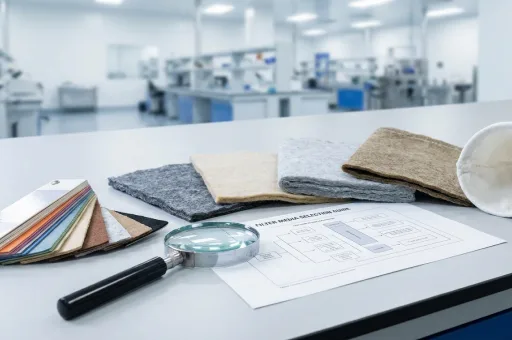
Selecting the correct low-temperature filter media is the foundation of baghouse reliability.
| Omela Filtrations Low-Temp Media | Max Temp (°C) | Chemical Resistance | Relative Cost | Typical Service Life |
|---|---|---|---|---|
| Polyester (PE) | 130–150 | Low (hydrolysis sensitive) | Low | 8–18 months |
| Acrylic Needle Felt | 125–140 | Excellent vs. moisture & acids | Medium | 18–30 months |
| Polypropylene (PP) | 90–100 | Excellent vs. acids/alkalis | Medium | 12–24 months |
| PTFE Membrane Laminated PE | 130–150 | Very high surface resistance | Medium-High | 20–32 months |
Engineering selection logic:
- High humidity + acid gas → Acrylic over Polyester
- Wet dust + chemical exposure → Polypropylene
- Fine sticky particles → PTFE membrane laminated felt
- Dry, stable conditions → Polyester remains cost-effective
Omela Filtrations often enhances base felts with membrane lamination or chemical finishes to extend service life.
People Also Ask
How does moisture affect low-temperature filter bag life?
Moisture accelerates hydrolysis in Polyester fibers.
When water vapor condenses:
- Polymer bonds weaken
- Tensile strength drops
- Fibers become brittle
- Bags tear during pulsing
Acrylic and PP fibers offer superior hydrolysis resistance in humid gas streams.
When should I use PTFE membrane on low-temperature media?
PTFE membrane is recommended when dust is:
- Ultra-fine (<5 µm)
- Sticky or oily
- Hygroscopic
- Difficult to clean
Membrane surface filtration prevents dust penetration and stabilizes pressure drop.
What is the most cost-effective low-temperature filter bag material?
It depends on dew point margin:
- Dry systems → Polyester lowest cost
- Humid systems → Acrylic longer life, lower TCO
- Chemical environments → Polypropylene or PTFE laminated media
Omela Filtrations evaluates operating data before recommending media to avoid premature replacement.
Omela Filtrations Authority Data
Expert Quote
“Low-temperature filtration failures are rarely caused by heat—they are caused by moisture chemistry. At Omela Filtrations, we engineer fiber blends and surface treatments specifically to resist hydrolysis and acid condensation.”
— Dr. Li, Chief Material Engineer at Omela Filtrations
Performance Data (Field Reference)
In a recent biomass power plant baghouse upgrade, Omela Filtrations supplied Acrylic + PTFE membrane filter bags:
- Emissions maintained at <8 mg/Nm³
- Stable ΔP operation for 26 months
- Bag replacement frequency reduced by ~45%
This demonstrates the importance of moisture-resistant media engineering.
Conclusion
Low-temperature baghouse filtration is defined not by heat—but by moisture, chemistry, and dust behavior.
Correct media selection reduces:
- Hydrolysis damage
- Sticky dust blinding
- Pressure drop instability
- Premature bag replacement
Long-term ROI comes from:
- Extended bag life
- Stable emissions
- Lower maintenance cost
- Reduced downtime
Contact Omela Filtrations technical team today for a customized filtration audit and quote.
Author

Jessica Ma – Senior Filtration Engineer, Omela Filtration
Jessica Ma is a senior filtration engineer at Omela Filtration, specializing in dust and liquid filtration. With over 15 years of experience, she focuses on optimizing baghouse performance, enhancing filtration efficiency, and developing high-performance solutions for industrial dust collectors and precision liquid filtration applications.