
Technical Overview
Silica Dust Filtration & Collection Systems are engineered dust-control solutions designed to capture respirable crystalline silica (RCS) generated during cutting, crushing, grinding, conveying, and thermal processing in industrial operations.
Key Technical Specs
- Filtration Efficiency: ≥ 99.97% @ 0.3 μm (with membrane-grade media)
- Operating Temperature: 130–260 °C (material-dependent)
- Target Emissions: ≤ 5 mg/Nm³ (compliant with OSHA / EU standards)
Omela Value
Omela Filtrations engineers silica dust filtration systems around material science, real process conditions, and verified lifecycle performance, not generic catalog ratings.
What is Silica Dust?
Silica dust is not just a housekeeping issue—it is a regulated occupational and environmental hazard.
In industries such as cement production, stone crushing, mining, foundries, and asphalt mixing, respirable crystalline silica (RCS) is continuously released during material handling and high-energy mechanical processes. Regulatory limits are tightening worldwide, with many plants now required to maintain stack emissions below 5–10 mg/Nm³ while simultaneously protecting worker health inside enclosed areas.
Traditional dust collectors often fail under these conditions due to filter blinding, rapid wear, or chemical degradation.
Omela Filtrations approaches silica dust control as an engineering problem, delivering filtration systems and filter media designed for high dust load, fine particle size, abrasion, and long service intervals.
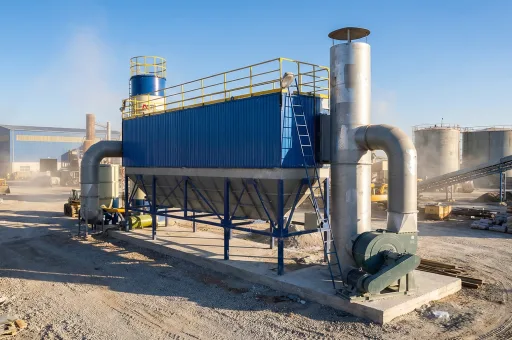
Technical Core
Challenges & Macro Trends
Silica dust filtration systems today must operate under increasingly severe conditions:
- Ultra-fine particle size: Silica dust frequently <2.5 μm, easily penetrating low-grade media
- High abrasion: Sharp, crystalline particles accelerate fabric wear
- Elevated temperatures: Especially in cement mills, kilns, dryers, and clinker handling
- High air-to-cloth ratios: Compact system designs demand higher filtration efficiency per m²
- Stricter exposure limits: OSHA PEL (50 μg/m³) and equivalent EU directives
These factors make material selection and surface treatment the decisive variables in system performance.
Material Selection / Product Deep Dive
For silica dust collection, Omela Filtrations typically engineers systems around needle felt filter bags with surface filtration capability, matched to process conditions.
Filter Media Comparison for Silica Dust Filtration
| Filter Media | Max Temp (°C) | Chemical Resistance | Relative Cost | Typical Service Life |
|---|---|---|---|---|
| Polyester (PET) | 130 | Fair (limited acid/alkali) | Low | 6–12 months |
| Acrylic | 140 | Good (acid-resistant) | Medium | 10–16 months |
| PPS | 190 | Excellent (acid/alkali) | Medium–High | 16–24 months |
| P84 (Polyimide) | 260 | Excellent | High | 20–30 months |
| PTFE (100%) | 260 | Outstanding | Very High | 24–36 months |
Omela Insight:
For silica dust, surface filtration is critical. Omela Filtrations frequently specifies PTFE membrane–laminated media or P84 blends to prevent deep dust penetration, reduce pressure drop, and extend cleaning cycles.
Engineering Q&A
How does silica particle size affect filter selection?
Silica particles are angular and extremely fine. If the filter media relies on depth filtration alone, particles embed into the felt, causing:
- Rapid pressure rise
- Difficult pulse cleaning
- Premature bag failure
Omela Filtrations addresses this by using membrane-coated or fine-fiber surface media, ensuring dust cakes on the surface and is removed efficiently during pulse-jet cleaning.
When should silica dust filter bags be replaced?
Replacement should not be based solely on time.
Key indicators include:
- Stable differential pressure rising beyond design limits
- Visible abrasion or pin-holing at bag bottom and snap bands
- Emissions approaching permit thresholds
In properly engineered systems, Omela Filtrations’ silica dust filter bags typically operate 18–30 months, depending on material and process severity.
Can silica dust be safely handled without cartridge filters?
Cartridge filters can work in low-temperature, low-abrasion environments.
However, in heavy industry and mineral processing, cartridge systems often fail due to:
- Rapid media damage from abrasion
- Limited dust holding capacity
- Frequent replacement cycles
For most industrial silica dust applications, baghouse systems with engineered needle felt media provide superior reliability and lower total cost of ownership.
Omela Filtrations Authority & Data
Dr. Li, Chief Material Engineer at Omela Filtrations:
“Silica dust is unforgiving. If the fiber selection or surface treatment is wrong, no amount of cleaning optimization will save the filter. We design the media to match particle behavior, not just temperature ratings.”
Field Performance Data
In a recent 5,000 t/day cement grinding line, Omela Filtrations supplied PTFE membrane–laminated PPS filter bags for silica-rich dust.
Results after 24 months of operation:
- Stack emissions: < 4 mg/Nm³
- Average pressure drop: 1,200–1,400 Pa
- Zero unscheduled bag failures
This performance was achieved under continuous high dust load and elevated operating temperatures.
Conclusion
Effective silica dust filtration is not about choosing the cheapest filter—it is about engineering for lifecycle performance.
By aligning material science, system design, and operating conditions, Omela Filtrations helps industrial plants achieve:
- Regulatory compliance
- Reduced maintenance downtime
- Lower total cost of ownership
- Improved worker safety
Contact Omela Filtrations’ technical team today for a customized silica dust filtration audit and engineered quotation.
Author

Jessica Ma – Senior Filtration Engineer, Omela Filtration
Jessica Ma is a senior filtration engineer at Omela Filtration, specializing in dust and liquid filtration. With over 15 years of experience, she focuses on optimizing baghouse performance, enhancing filtration efficiency, and developing high-performance solutions for industrial dust collectors and precision liquid filtration applications.