
Dust collector failure in a foundry rarely happens without warning.
In most cases, small, observable signals appear weeks or months before a major breakdown—rising pressure drop, visible dust carryover, abnormal bag wear, or unstable cleaning cycles.
For foundries operating under high heat, abrasive dust, and strict emission limits, missing these early warning signs leads directly to unplanned shutdowns, compliance risks, and rising operating costs.
This guide explains how to identify the subtle indicators of filtration system failure, why they occur in foundry environments, and how Omela Filtrations helps plants diagnose and correct problems before they become critical.
The Foundry Challenge: A Harsh Environment for Filtration
Foundry dust collection systems operate in one of the harshest industrial environments. The combination of extreme conditions creates a very narrow operating window where small deviations can trigger cascading failures.
Typical challenges include:
- High-temperature exhaust streams from furnaces and shakeout lines.
- Highly abrasive particulates such as silica sand, metal fines, and binders.
- Chemical exposure from resins, phenols, and curing agents.
- Strict regulations requiring stable control under 10 mg/Nm³.
To maintain efficiency in these conditions, operators must move beyond reactive maintenance and look for specific early indicators.
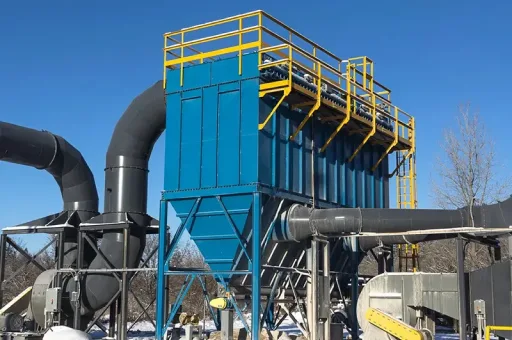
4 Critical Early Warning Signs of System Failure
The earliest indicators of failure are operational, not catastrophic. Based on Omela Filtrations’ field audits, over 60% of premature failures are detectable at least 30–60 days before bag rupture—if you know where to look.
1. Gradual Increase in Differential Pressure (ΔP)
A steady rise in ΔP that doesn’t return to baseline after cleaning cycles is the most common red flag.
- What it means: This often indicates dust blinding (particles embedded in the fabric), pore blockage, or insufficient cleaning energy.
2. Visible Dust at Stack or Hopper Leakage
Seeing dust puffs at the stack or accumulation around the hopper isn’t just a compliance issue; it’s a symptom of structural breach.
- What it means: Early bag pinholing or issues with the snapband sealing are likely occurring.
3. Uneven Bag Wear Patterns
During routine inspections, look for localized abrasion, particularly near the cage rings or bottom cap.
- What it means: This signals misalignment, poor cage fit, or excessive dust velocity effectively “sandblasting” specific areas of the filter.
4. More Frequent Cleaning Cycles
If your pulse-jet cleaning system is triggering more frequently without a corresponding change in production volume, the system is struggling.
- What it means: Filter permeability is declining, and the bags can no longer shed dust effectively.
The Root Causes: Why Do Bags Fail Early?
Foundry environments combine two destructive forces that accelerate wear: Thermal Stress and Mechanical Abrasion.
Most standard materials cannot withstand the specific demands of a foundry:
- Polyester softens above 130°C.
- Acrylic degrades under continuous heat.
- PPS suffers from hydrolysis when acidic moisture is present.
Furthermore, silica sand and metal fines act like grinding media. If the air-to-cloth ratio is too high, particle velocity increases, cutting through fibers rapidly.
The Material Engineering Solution
“Most dust collector failures are not caused by defective bags, but by a mismatch between process conditions and material selection,” says Dr. Li, Chief Material Engineer at Omela Filtrations.
To combat this, Omela often specifies:
- P84 (Polyimide): For high-temperature stability and fine dust control.
- PTFE Membrane Laminates: For sticky or chemically aggressive dust.
- Reinforced Wear Cuffs: Specifically for shakeout and reclaim systems to resist abrasion.
When to Replace Filter Bags (Before It’s Too Late)
Waiting for a visible bag rupture is a costly strategy. Proactive replacement protects downstream equipment and ensures compliance.
Best-practice replacement triggers include:
- Persistent High ΔP: Pressure drop remains high even after cleaning optimization.
- Fluctuating Emissions: Readings become unstable rather than remaining flat.
- Recurring Damage: Repeated bag damage appears in the same location (signaling a system flow issue).
- Service Life Benchmarks: Bags reach 70–80% of their proven service life under similar conditions.
Proven Performance
In a recent 6,000-ton/day foundry project, Omela Filtrations’ P84 filter bags maintained stable emissions below 8 mg/Nm³ for over 26 months. By scheduling replacement proactively based on data rather than failure, the plant avoided unplanned downtime entirely.
The Omela Advantage: Engineered for Longevity
Omela Filtrations approaches dust collection from a material engineering perspective, verifying every production batch through fiber tensile testing, permeability checks, and strict dimensional inspection.
Internal performance tracking across metallurgy and foundry projects shows:
- Up to 35% longer service life when filter media is selected based on dust morphology.
- 20–30% reduction in compressed air consumption through optimized permeability.
- Consistent compliance even under fluctuating furnace loads.
Conclusion
Dust collector failure in foundries is predictable. Early warning signs—rising pressure, uneven wear, and unstable cleaning—are the language your system uses to tell you something is wrong.
By combining process knowledge, material engineering, and strict quality control, Omela Filtrations helps foundries move from reactive repairs to predictive filtration management.
Author

Jessica Ma – Senior Filtration Engineer, Omela Filtration
Jessica Ma is a senior filtration engineer at Omela Filtration, specializing in dust and liquid filtration. With over 15 years of experience, she focuses on optimizing baghouse performance, enhancing filtration efficiency, and developing high-performance solutions for industrial dust collectors and precision liquid filtration applications.